Monday, 12 December 2016

Tuesday, 20 September 2016


FOCUSING ON A DRISHTI
A drishti (view or gaze) is a specific focal point that is employed during meditation or while holding a yoga posture. The ancient yogis discovered that where our gaze is directed our attention naturally follows, and that the quality of our gazing is directly reflected in the quality of our mental thoughts. When the gaze is fixed on a single point the mind is diminished from being stimulated by all other external objects. And when the gaze is fixed on a single point within the body, our awareness draws inwards and the mind remains undisturbed by external stimuli. Thus, the use of a drishti allows the mind to focus and move into a deep state of concentration. And the constant application of drishti develops ekagraha, single-pointed focus, an essential yogic technique used to still the mind.
A drishti is commonly used in meditation to focus and concentrate the mind. The most useful drishti points used are the breath and the third eye center. External focal points can also be used, such as the tip of the nose, a candle or mandala.
In yoga postures, a drishti is used to deepen the primary movement of the pose, as well as to keep the mind engaged and focused. To use a drishti while in a yoga pose, simply select the point where your gaze is naturally directed by the alignment of the posture. The use of drishtis in yoga postures is to be developed slowly over time. First one must develop and focus on the alignment of pose, then the breath, and then finally the drishti. Using a drishti is especially helpful if you are holding a posture for an extended period of time, and will be enormously helpful while practicing balancing poses.
In Ashtanga yoga, eight specific drishtis are used and described: Nasagrai Drishti, gaze at the tip of the nose, as used in upward facing dog and standing forward fold poses. Angusta Ma Dyai Drishti, gaze at the thumbs, as used in warrior I. Nabi Chakra Drishti, gaze at the navel, as used in downward facing dog. Pahayoragrai Drishti, gaze at the toes, as used in hand to toe pose and most seated forward bends. Hastagrai Drishti, gaze at the hands, as used in triangle and warrior II. ParsvaDrishti, gaze to the side, as used in seated spinal twists. Urdhva Drishti, gaze upwards, as used in warrior angle, balancing half moon, and prayer twist. Naitrayohmadya or Broomadhya Drishti, gaze at the third eye or forehead, as used in fish, upward forward fold, and reverse warrior II.
When using a drishti, do not strain the eyes. The muscles around the eyes should be relaxed and the gaze should be soft. Generally, it is recommended to use bahya (external) gazing for externally oriented yoga practices and antara (internal) gazing for contemplative and meditative practices. But there is also value to having the eyes closed and using antara drishti during yoga postures, as this creates a deep state of meditation and inward focus while holding the pose.
In bhakti yoga, drishti is used in a slightly different way: a constant loving and longing gaze is turned toward the concept, name or image of God. Drishti can also be thought of in a broader context, of having the proper view or perspective of one’s life. By developing the ability to adapt one’s perspective to accommodate the continuous change in the world, we can avoid the unnecessary attachments that cause us suffering.
http://www.yogabasics.com/learn/focusing-on-a-drishti/
Sunday, 11 January 2015


Wednesday, 15 October 2014


Sunday, 5 October 2014
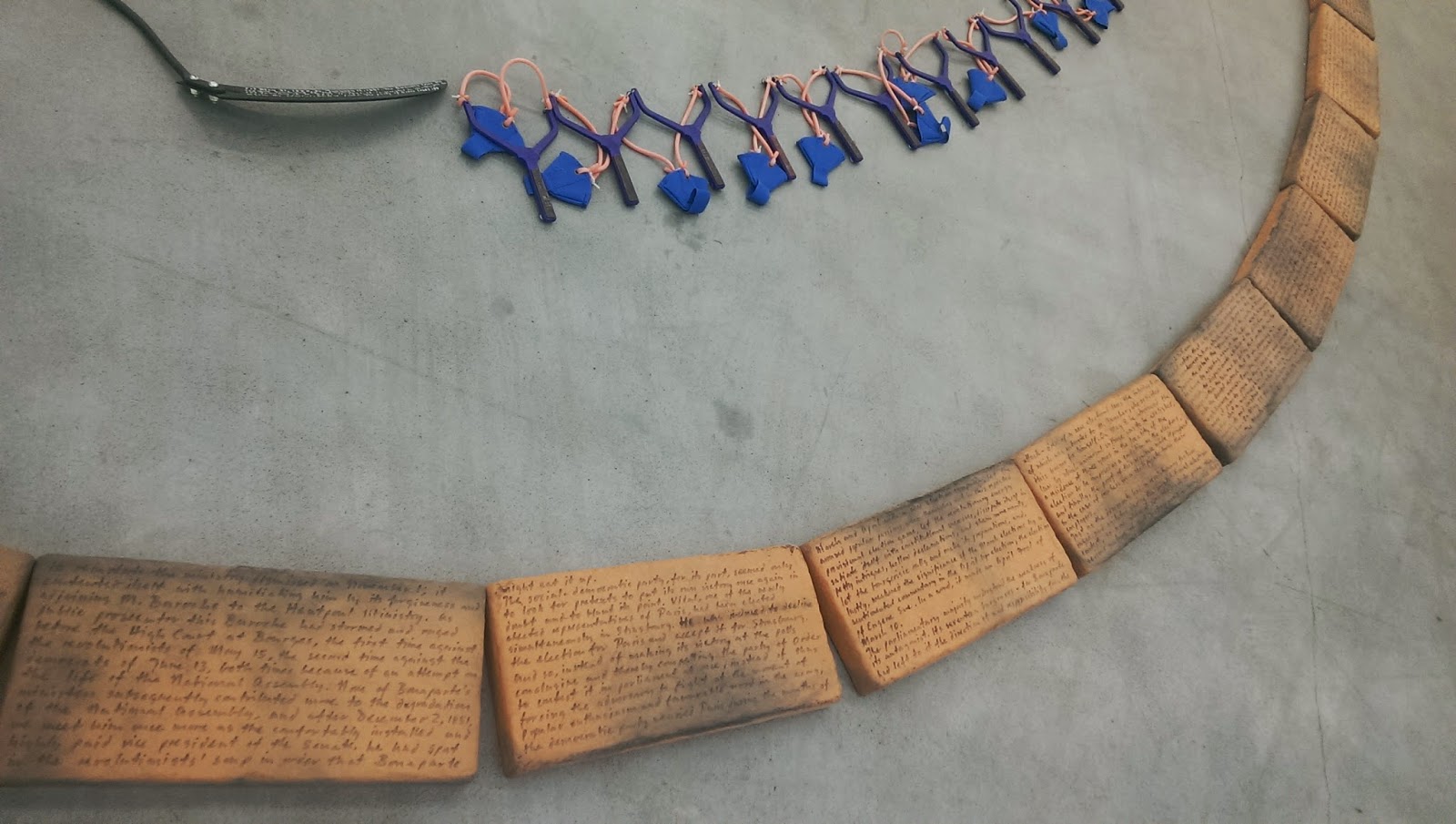
Colin Darke: Grotesque Mediocrity at MAC
Despite references to Brecht of which I have no knowledge. I enjoyed this installation as it immediately offered way of reconsidering and arranging objects, which is a process that Vaso and I will be undertaking when arriving in Athens and setting up Pantone Green and A Glass of Lemonde.


Saturday, 27 September 2014

Wednesday, 24 September 2014


Monday, 22 September 2014


Thursday, 11 September 2014
British Council Art For Social Development
I'm delighted that Vaso and I will be collaborating once again. We have been chosen by the British Council to run a workshop in Kypseli. They will be funding us to go out there. I can't wait.
Currently, Vaso and I are turning our proposal into reality by organising how it will logistically put together. This is the space that we finally settled for; it is available, cheap, in Kypseli. It's going under construction.


Currently, Vaso and I are turning our proposal into reality by organising how it will logistically put together. This is the space that we finally settled for; it is available, cheap, in Kypseli. It's going under construction.
Corporate images


Wednesday, 10 September 2014
Performance with Angela
Around two years ago Angela and I performed Skype conversations together. One of us would perform movements while the other copied. Often we'd play with the frame of the computer screen, as a boundary that we could not step outside of.
At the end of this month, Angela will have an assessed performance as part of her degree show and has asked that we re-perform via Skype. She offered a book to help us develop the idea: Medical Indoor Gymnastics, or a system of hygienic exercises for home use to be practiced.
From what I gathered, she liked the virtual meditation performance I gave with will last November at her conference 'K'

At the end of this month, Angela will have an assessed performance as part of her degree show and has asked that we re-perform via Skype. She offered a book to help us develop the idea: Medical Indoor Gymnastics, or a system of hygienic exercises for home use to be practiced.
From what I gathered, she liked the virtual meditation performance I gave with will last November at her conference 'K'
I taught how to make face masks, with Will as my model and then I proceeded to give a meditation class.
I also think Angela liked the general idea of the skill exchange library, that it tries to break away from the things we do for money and instead focuses on the things we do for pure pleasure. That perhaps was the case with meditation and the yoga classes that also ran as part of SEL at various events. In the SEL is definitely a continuation of counter-stress activity taking place.
The book Angela suggested claims that we use our heads too much and our bodies, not enough. So the exercises are a series that can be repeated alone and should be practiced regularly.
Angela and I have been running through these exercises via the internet. I have just recorded myself reading out the instructions for each exercise. The idea is that these instructions will play out as Angela and I follow them.
Sunday, 3 November 2013
Preparations for the next skill exchange

Sunday, 13 October 2013


Monday, 16 September 2013


Tuesday, 30 July 2013


Subscribe to:
Posts (Atom)